The Blank Page Problem
When generative AI arrived, we bet it could fix the oldest problem in onboarding: customers who know what they want to build, stopped cold by an empty page. Six months of roadmap, shipped in six weeks — and twice as many customers made it through.
The record
CE/W-03
Context
Onboarding friction was one of the biggest drivers of drop-off across GoDaddy’s experiences. Naming the business is the exciting part. Then comes everything else. The domain, the site, the logo, the Instagram presence, and the idea stalls before it starts.
Could generative AI close that gap? GoDaddy had the products, the customer data, and a head start. Waiting meant losing that advantage.
What we had to be right about
The honest question wasn’t “can we add AI.” Anyone could. It was whether we could use AI to move customers forward faster without creating confusion, distrust, or low-quality results. We set a bar we were willing to fail: if any of four questions came back no, we wouldn’t ship. Could it perform reliably at GoDaddy’s scale? Was the output genuinely useful, not just impressive? Would customers trust and enjoy it? Would it measurably improve onboarding and engagement?
The bet
My role sat squarely between strategy and execution: shaping the problem and defining what “good” meant, assembling the multi-disciplinary team across UX, content, and UX engineering, establishing a single source of truth in Figma for rapid iteration, and holding the line on learning-over-polish when speed pressured us to skip validation.
We started where every creative project thrives: a spreadsheet. MVP scope, swimlanes, and KPIs across product areas: unglamorous, but it’s the reason ten-plus teams could move in the same direction at once.
The operating decisions, in the order they mattered:
Learning before polish. We focused first on interaction patterns and feedback loops. No branding or visual identity was created until the patterns were validated.
Speed over completeness. Roughly six months of roadmap executed in six weeks, with design done in about four. That required daily communication, frequent demos, and treating scope change as normal rather than exceptional. Design reviews ran weekly or twice weekly because anything slower couldn’t keep up with what we were learning.
Trust over magic. Early testing surfaced a fear we hadn’t fully anticipated: customers were afraid of losing their work when AI touched it. We built non-destructive patterns throughout so exploration always felt safe and reversible.
Planning for imperfect output. Cutting-edge models produce wrong or uncompelling results some meaningful percentage of the time. We designed clear recovery paths so a bad generation was a shrug and a retry, never a dead end.

What shipped
The AI starting-point treatment shipped across the surfaces where the blank page hurt most: provisioning and onboarding, including business-category selection; the website builder; logo automation; and the marketing tools. In each, an empty field became a generated, editable starting point, wrapped in the same non-destructive review-and-retry pattern so customers could explore without fear of losing their work. We also wrote the content guidance for how generative AI should be implemented across GoDaddy, turning what we learned here into a repeatable standard rather than a one-off.
Outcomes
- Onboarding completion doubled. Twice as many customers made it all the way through.
- Interaction and engagement rose sharply once the blank-page problem was removed. Customers no longer had to start from nothing.
- First to market in the category, with the iteration speed to stay ahead.
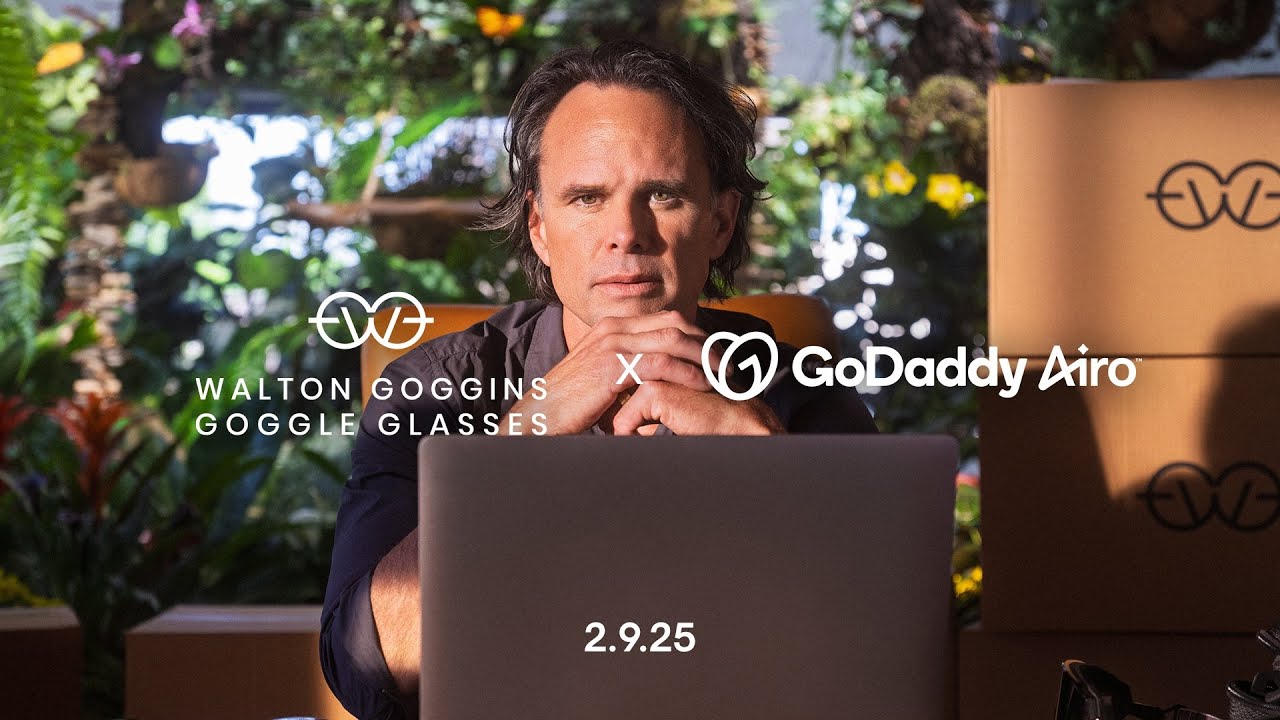
- The initiative became Airo, now a full suite of AI tools with a dedicated team. It went on to anchor a GoDaddy Super Bowl campaign.
- The release was a step change in market perception of GoDaddy and its tooling.
What I’d do differently
The pace was a tool, not a culture shift. Six months in six weeks worked because everyone knew it was temporary. I’d be explicit about that framing from day one next time. Name the surge, name its end date, because the mode is corrosive the moment it stops being exceptional.
We followed the sparkle. The market converged fast on wands, sparkles, and purple as the visual language of AI, and we largely went with convention. Defensible for speed and recognizability, but worth arguing whether the first mover should have set the convention instead of adopting it.
Designing against unreliable output is a discipline, not a patch. The recovery paths we built were reactive. Knowing what I know now, I’d treat model fallibility as a first-class design constraint from the first wireframe, not something testing reveals.